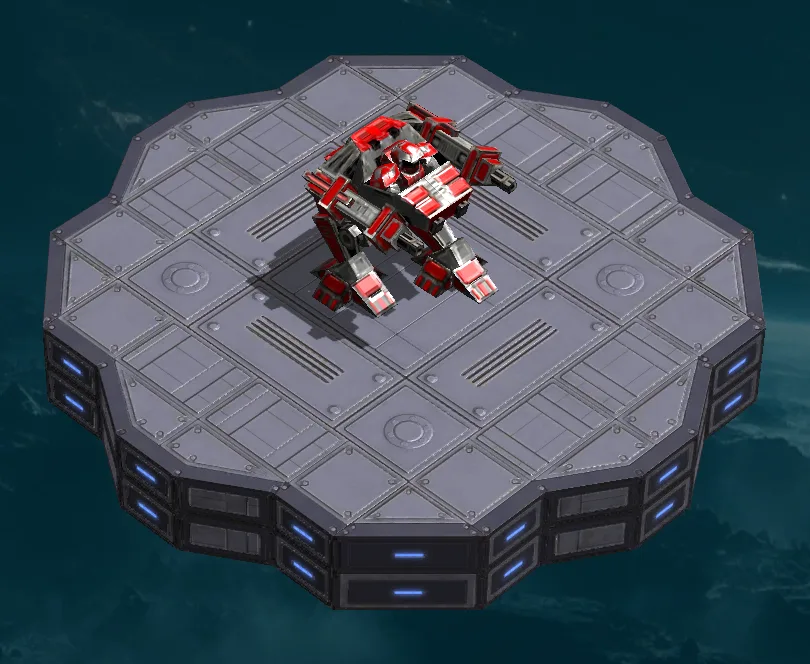
The Devastator is a durable ground robot with bonus damage against Tanks, Titans, and Lynxes. It has long attack range but moves slowly. It is ineffective against Peacemakers and Thunders. Produced in: Barracks. Requires: Factory.
Health
225
Damage
10
Damage interval
1
Speed
2
Visibility distance
9
Attack distance
8
Aggression distance
12
Bonuses
+200% attack against Tanks and Titans
+125% attack against Lynxes
Who is the Devastator?
If the conflict cannot be settled peacefully, it is time to devastate!
The community also calls the Devastator “Razrukh” or “Rukh.”
The Devastator is a tactical unit, useful in positional defense and in focusing fire on priority targets. It forms a sturdy tanking core for a ground army.
How to play the Devastator?
The Devastator is useful as soon as it is produced, but becomes especially strong after earning chevrons. Its priority targets are Lynxes, Tanks, Tanks in N.A.T.A.S.H.A. mode, and Titans, all of which take bonus damage.
Devastator strengths
Long attack range helps focus fire on important targets and keep experienced Devastators behind the front line.
Bonus damage against Titans, Tanks, and Lynxes lets the Devastator eliminate these targets quickly and earn experience.
The Devastator has high health and can absorb damage while protecting more vulnerable allies.
It is especially effective at forcing Tanks out of N.A.T.A.S.H.A. mode thanks to its long range, bonus damage, and the deployed Tank’s double incoming damage.
After Healing is researched, a Balloon restores the health of a Devastator on board.
Devastator weaknesses
Hits Peacemakers, Waves, and buildings without any bonus, so the composition depends heavily on scouting.
Automatically attacks the nearest target. To make use of its bonus damage, you often need to select the priority target manually.
Low speed makes retreating after a lost battle difficult: straggling Devastators are easy prey for Thunders and Peacemakers.
Vulnerable to Peacemakers and Waves. The Peacemaker is considered its direct counter.
The Devastator’s role on the battlefield
Early on, the Devastator primarily defends the base. Good building placement creates narrow passages where it can drive off early Lynxes even without a Gate and keep them from killing Workers.
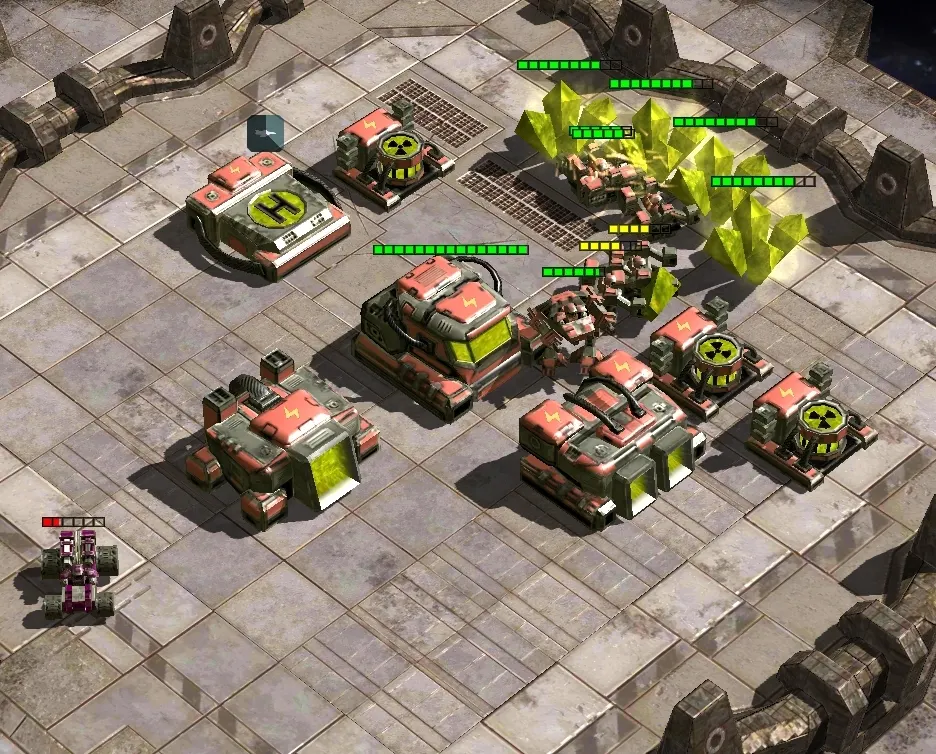
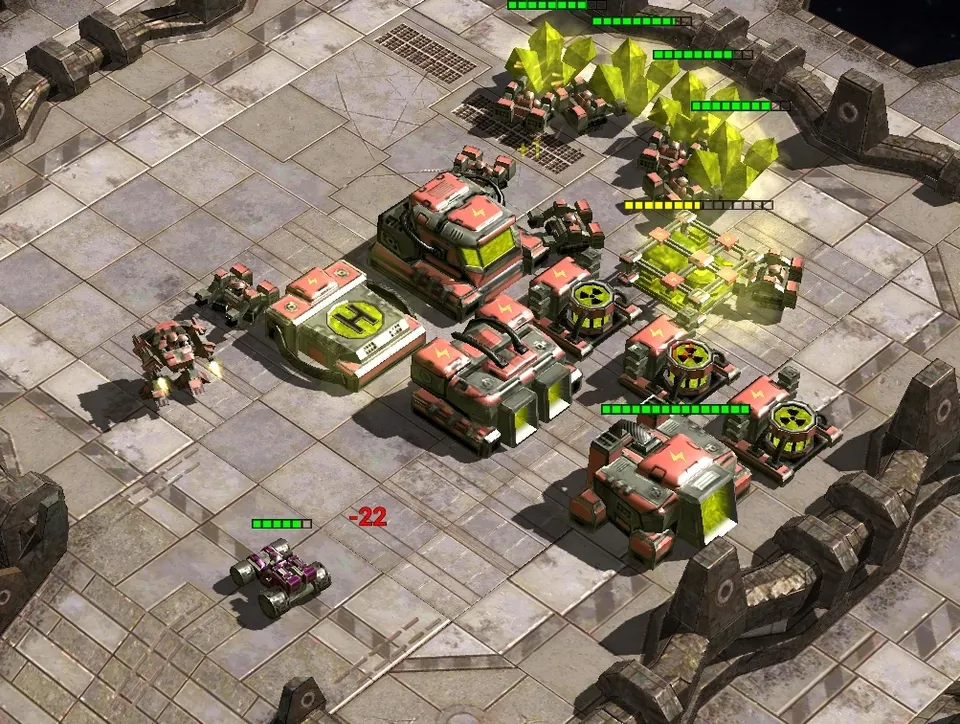
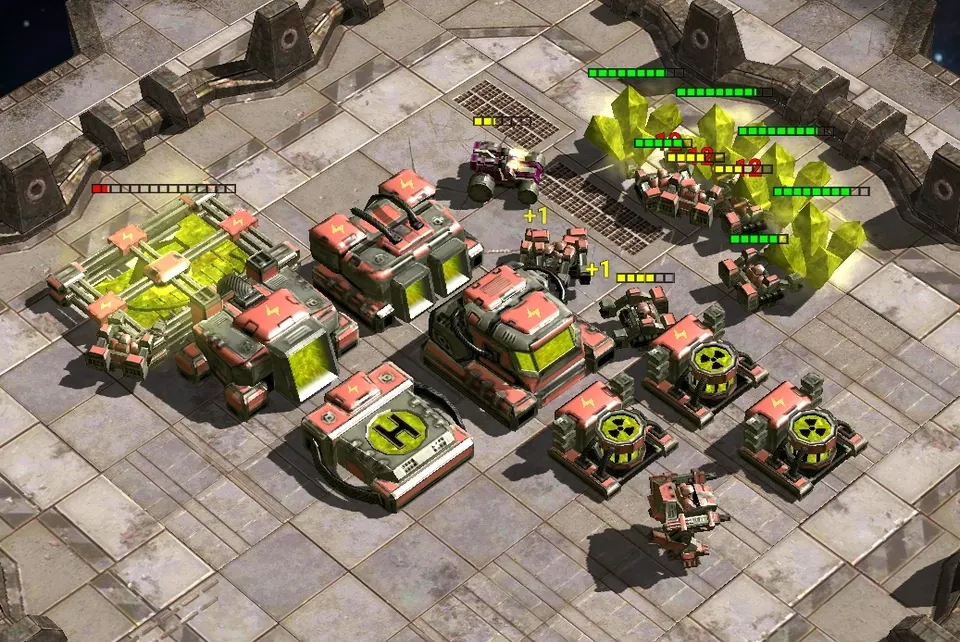
Below are examples of good and bad layouts:
In the first layout, the Lynx can reach the Workers, but the Devastator drives it off by maneuvering through the passages between buildings.
In the second layout, tightly packed buildings make it harder to reach the Workers, and the Lynx comes under Devastator fire on the way back.
In the third option, the opponent can drive around the Devastator on either side and attack the Workers. Even if the Devastator stands directly on the harvesting line, the enemy can damage Reactors, buildings under construction, and the Workers building them. This slows base development until reinforcements arrive.
The number of Devastators you need depends on scouting and the enemy composition:
If the opponent adds Lynxes, increase your Devastator count and expand to a second base when possible. Watch for a transition into aircraft or Balloons: you will need Hawks, Titans, or Turrets against air and a home garrison against drops.
If the opponent is also producing Devastators, consider attacking with a deployed N.A.T.A.S.H.A. Tank as bait, a Wave, and Peacemaker or Lynx support depending on the enemy composition. This can create a local trade advantage or earn experience for your army.
If the opponent focuses on Peacemakers or has built several Barracks, slow Devastator production and add the appropriate counter.
Against several Tanks in N.A.T.A.S.H.A. mode, add two or three Devastators. Your own deployed Tank helps prevent the opponent from forcing an unfavorable fight.
If the opponent transitions into many Titans, add a second Barracks and actively produce Devastators and Tanks. Early on, one Devastator will not stop a Titan: they become a full counter only in sufficient numbers or with chevrons. After the first trade, load the surviving Devastators into a Balloon with Healing and add more if Titan production continues.
Besides their main role, Devastators can absorb damage for Peacemakers and keep enemy Lynxes away from them. Peacemakers deal especially high damage per energy, so preserve the Devastators protecting them while enemy Lynxes remain.
The Devastator works best in a mixed army with proper target selection. In the right composition, it becomes a durable core for ground forces.
Tips
If an enemy Tank in N.A.T.A.S.H.A. mode is protected by an army, load two or three Devastators into a Balloon and drop them on the exposed side. The opponent will have to undeploy the Tank or lose it.
Against mass Titans, do not send Devastators into battle one at a time. Aim for two Devastators or Tanks per enemy Titan.
Using the Rukh in builds
Rukh-Lynx-Hawk
A classic early-game composition: the first Devastator protects the base from Lynxes, your own Lynx scouts or attacks the economy, and the Hawk provides early defense against Thunders while scouting the enemy base.
There are several ways to develop into this build.
The earlier one:
Opening order: five Workers → Reactor → Barracks at 12 ore → sixth and seventh Workers → Factory → eighth Worker → second Reactor. Then choose one of the following:
Lynx → Devastator → Heliport → third Reactor → Hawk.
OR
Heliport → Devastator → Lynx → Hawk → third Reactor.
Adjust the order to your goal: an early Lynx adds pressure, a Devastator makes the opening safer, and an early Heliport provides faster scouting and air defense. Another option is:
Five Workers → Reactor → Barracks at 12 ore → sixth and seventh Workers → Factory → eighth Worker, sent immediately to build a Gate → Gate → Heliport → Devastator → second Reactor → Hawk → third Reactor. This option provides fast scouting and air defense but delays the Lynx.
The later one (with a stronger economy):
Alternative opening: five Workers → Reactor → Barracks at 14 ore → sixth, seventh, and eighth Workers → Factory. Then:
Peacemaker → second Reactor → Heliport → Devastator → Lynx → Hawk → third Reactor. A safe option against an unexpected early Peacemaker attack.
OR
Send the eighth Worker to build a Gate immediately → second Reactor at 20 ore → Heliport → Lynx → Devastator → Hawk → third Reactor. The Gate protects against an early Peacemaker and Lynx incursions, while the Heliport enables a quick transition to Hawks.
OR
Second Reactor → Heliport → Devastator → Lynx → Hawk → third Reactor. This is the classic option without a Gate, so the Devastator is produced first.
OR
Second Reactor → Devastator → Lynx → Heliport → third Reactor → Hawk. A safer option with two early ground units, but the Heliport must be built later and farther from the main base.
Unit order depends on scouting and your chosen attack timing. Without a Gate, producing the Devastator first is safer. If the passage is already blocked, you can start with a Lynx for scouting.
RRR
The name RRR comes from the hotkeys for the Devastator, Lynx, and Hawk. It is not only an opening order but the foundation of a complete mid-game composition. Its strengths are scouting and flexibility: add counters to the enemy army while keeping the three-unit core.
Tank + Rukh (forward production)
The Tank-and-Devastator build places an early Barracks and Factory near the enemy base, within reach of its harvesting line. The goal is to deny income by firing on Workers with a Devastator and a Tank in N.A.T.A.S.H.A. mode. The terrain can keep the deployed Tank safe and cover the Devastator’s retreat.
Attack once the Tank is ready. Near the position, build a Barracks for a Titan or a Turret for air defense. In the version without a Devastator, produce a Titan immediately and wait for it before beginning the assault.
This build is risky: a failed siege can cost you the production buildings, and there is usually not enough time or ore to rebuild them.
Which units pair well with the Devastator?
Rukh + Tank
The Devastator works well with the Tank against mass Titans, especially when there is no time to build a second Barracks.
Rukh + Peacemaker
The Devastator protects Peacemakers from Lynxes and absorbs some incoming damage. A Wave strengthens the composition further by controlling the enemy.
Devastator chevrons: what they are and how they work
Chevrons are curved stripes shown above the unit. They have three levels:
+10% health and damage
+20% health and damage
+30% health and damage + regeneration
To earn one chevron, the Devastator must deal a certain amount of damage to enemy units.
Upgrades in the Barracks
Each upgrade level adds another 10% of base health or damage to infantry. The cost rises in sequence: 10 → 20 → 30 ore.
Armor IArmor IIArmor III+10%, +20%, +30% to infantry health.
Attack IAttack IIAttack III+10%, +20%, +30% to infantry base attack.
No chevrons
1 chevron
2 chevrons
3 chevrons
No upgrades
Health: 225 Damage: 10
Health: 248 Damage: 11
Health: 270 Damage: 12
Health: 293 Damage: 13
Attack I + Armor I
Health: 248 Damage: 11
Health: 270 Damage: 12
Health: 293 Damage: 13
Health: 315 Damage: 14
Attack II + Armor II
Health: 270 Damage: 12
Health: 293 Damage: 13
Health: 315 Damage: 14
Health: 338 Damage: 15
Attack III + Armor III
Health: 293 Damage: 13
Health: 315 Damage: 14
Health: 338 Damage: 15
Health: 360 Damage: 16
What does the Devastator say?
New Devastator!
The power is in me!
Devastate!
Leave no stone unturned!
To shreds!
Tear it down!
Walking...
I’m on foot...
Are you crazy?
Straight through!
The mission is feasible.
That is my target!
Almost there...
Don’t move!
Don’t anger me...
Devastator FAQ
Who is the Devastator effective against?
The Devastator deals +200% damage to Tanks and Titans and +125% to Lynxes. It deals normal damage to Peacemakers, Waves, and buildings.
What counters the Devastator?
The Devastator is vulnerable to Peacemakers and Waves. Because of its low speed, Thunders can also catch Devastators that fall behind the army.
How does the Devastator defend the base in the early game?
The first Devastator protects Workers from early Lynx incursions: with good building placement, it maneuvers through the passages and drives the attacking Lynx away.
How many Devastators do you need against Titans?
Aim for two Devastators or Tanks per enemy Titan. Do not send Devastators into battle one at a time: they need sufficient numbers or earned chevrons.


 RU
RU EN
EN 12
12
 2
2
 25
25



Join us!